
Most of us now carry a quiet record of our own health. Sleep from a watch. Heart rate. Steps. A headache we logged once and forgot. It sits in a health app, in lines and rings, and mostly it doesn't tell you anything.
Odhi is my attempt at making that record useful without making it anyone else's business. It reads the data already on your phone, sets it against your own usual, and shows what stands out. Nothing leaves the phone.
It isn't on the App Store yet. This is what it is, how it behaves, and what it deliberately doesn't do.
Against your usual, not against everyone
A sleep score that compares you with a population average isn't very helpful. You are not the average. A seven-hour night might be ordinary for you, or a short one.
So Odhi only compares you with you. It looks at recent weeks against your earlier weeks: sleep shorter than usual, bedtimes drifting later, activity slowly falling, a resting heart rate that has stayed up for several days. Each note comes with its numbers, how much data was behind it, and what it can't tell you. Some days there's nothing to say, and Odhi says that too.
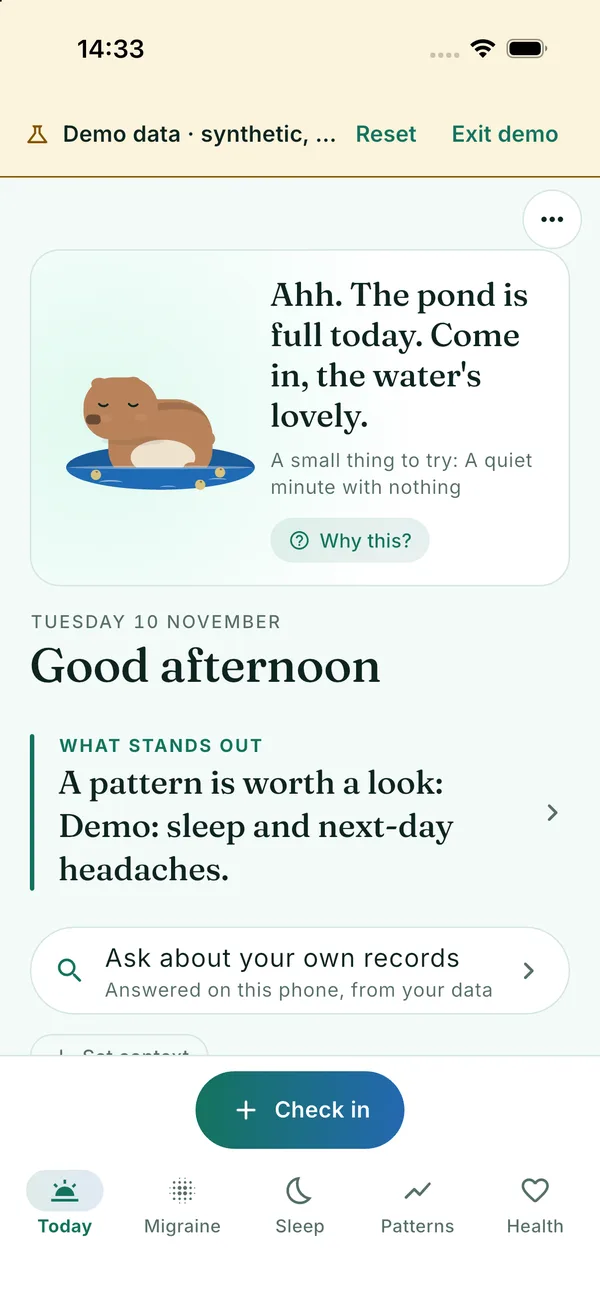
The screen above uses made-up sample data. That's what demo mode shows, and it's labelled as such.
Observations only
Odhi is not a medical app. It gives observations, not a diagnosis, and it won't tell you that you are well or unwell. When it says something is worth mentioning to your GP, that's a prompt to ask, not a conclusion.
I wrote down a few rules before building, and they still hold:
- No health score out of 100. No streaks. No guilt about the night you didn't track.
- No red alarm colours, and no words like "risk" or "abnormal".
- Wording like "associated with" and "may", never "because".
- No advice about medicine, ever.
A capybara called Odhi, and a bird called Pip
Health data can feel heavy, so Odhi comes with company. A small capybara and a bird called Pip drift around the Today screen. They never look worried, never scold, and never mention a condition. If they aren't your thing, one switch in Settings makes them disappear, and everything else stays the same. There's also a home-screen widget that shows a picture and a single short sentence, with no numbers on it.
Private, properly
Odhi has no account and no server. Your records live in an encrypted database on your phone. The release build can't use the internet at all, and the app has no analytics, no ads and no crash reporting. Odhi reads Apple Health and writes to it only if you turn on the optional setting to save lab results there.
You can export everything, erase everything, or delete the app and take it all with you. The full details are in the privacy policy.
The experimental parts
A few things I'm trying are not ready to be called finished. They are off by default and kept out of the App Store version:
- an optional overnight listen that measures snoring, where sound is turned into a few numbers and never stored or sent,
- a migraine heads-up that only appears if a test on your own history beats simple guesses,
- a gentle "pace" word for whether your routines are steadier, about the same or less steady.
They have been tried on made-up data and in internal test builds, and no further. They are not checked against sleep studies or clinical measurements. I've written up what they draw on, what they don't claim, and how they work, on the research pages, and I explain the thinking in How Odhi reads research.
What's next
I'd like to get Odhi onto the App Store, and I'd like to hear from you first if you'd like to try it. You can tell me through the contact form and I'll get back to you. Please don't send health information.